Amor Prohibido
Pau S. Pescador
Opening Saturday, June 6th. On view through July 18th, 2026
For inquiries or questions, please reach out here.
-
Tyler Park Presents’ Amor Prohibido, artist and filmmaker Pau S. Pescador’s third exhibition with the gallery. Amor Prohibido is a continuation of the artist's investment in the photographic medium, its relationship to performance and the corresponding photographic document.
The exhibition title translated in English as “the forbidden love" and has been most famously used in the title of the 1994 eponymous Selena pop song. A play of words as Pescador reflects upon their latine trans identity under the second Trump presidency. Pescador’s prior exhibition, When home becomes body (2023) focused upon the artist retreating into the privacy of their own home. Amor Prohibido becomes a postulation of how an individual can return to public space, even within a moment when their identity is considered unwelcome by the greater government. Pescador considers how their trans body operates within public space. Does its visibility become immediately political? Can there be pleasure or humor within this daily navigation?
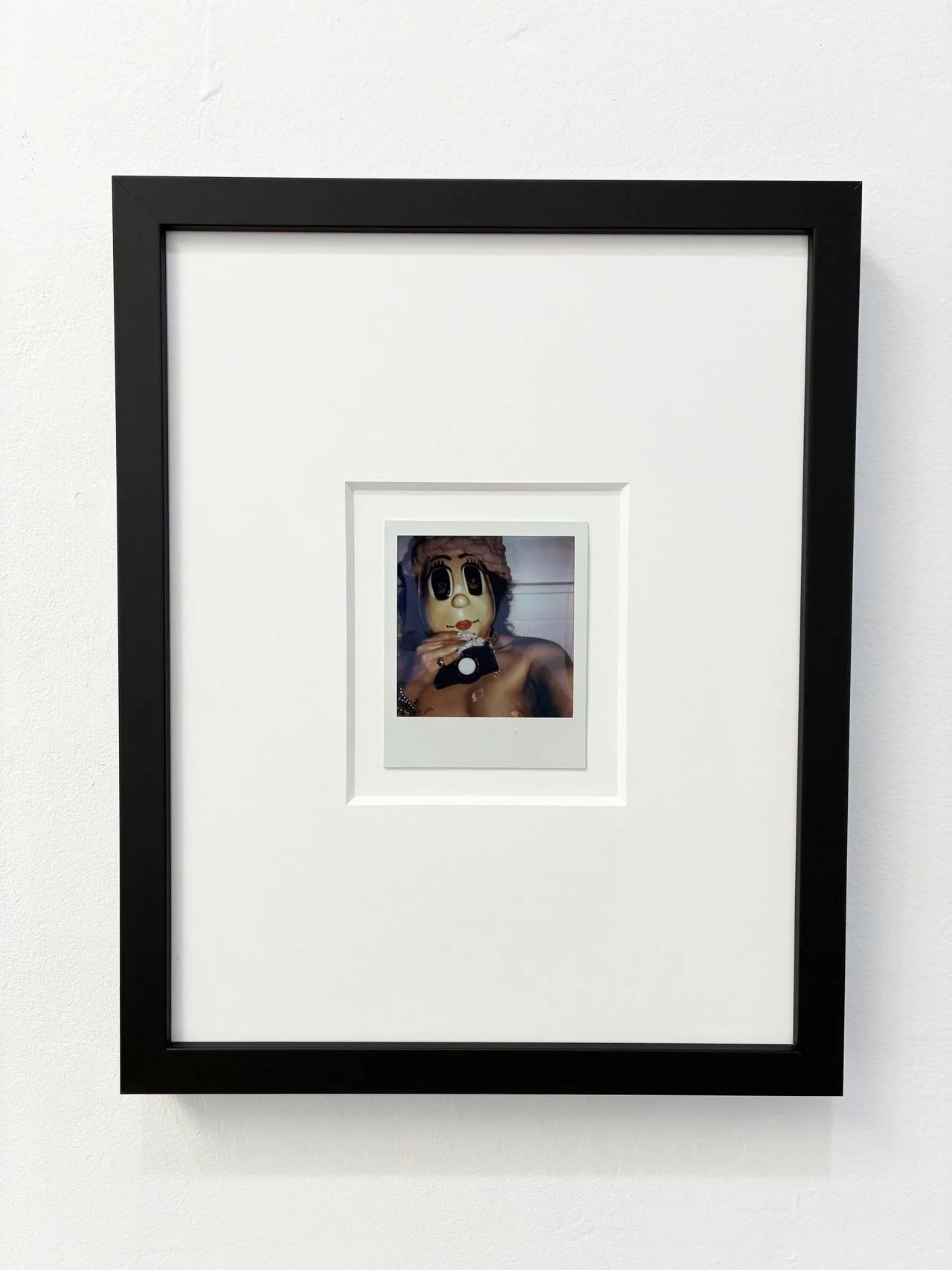
Amor Prohibido is the first of two bodies of photographs within the exhibition. The series of works consists of Polaroid self-portraits of Pescador taken within her own bed. Polaroids have been long used within photographic history due to the immediacy of the medium, allowing for a moment to be transcribed into an instantaneous photographic object. The uncertainty of the Polaroid chemical process as well as the gritty pin-up nature of the images (dirty gray sheets, Pescador’s nude body, messy hair, and the flash of the camera) produces a humorous juxtaposition as the artists poses alongside masks and puppets, reinforcing the physicality of the Polaroid object as a witness to the privacy as well as absurdity of each image.
The second photographic series, How do you solve a problem like… is a set of gridded 4x6 photographic prints depicting Pescador gathering and assembling various colorful props in front of different commercial buildings and empty lots around Los Angeles. Each set of photos present the artist placing various materials together. A trial and error as objects fall over, collapse and then are rebuilt. Though a specific purpose to each act is not present, anthropomorphic shapes begin to form. These sets of photographs become less about the completion of a task, but as a public practice, ephemerally taking up space solely to perform for the camera. The work’s title is a reference to the desire of problem solving within contemporary art such as Sol LeWitt’s manifesto “Sentence on Conceptual Art”, 1968 to a title shortening of the Rodger and Hammerstein song “How to Solve a Problem like Maria” from the musical the Sound of Music. Each example becomes potential strategies for questioning pre-existing systems, structures and histories even if only as a consideration or gesture of play.
Accompanying the two series of photographs is The body becomes space… a video artwork consisting of filmed and found media as well as short text segments that illuminates the artist's lived experience attempting to move through the world at a moment when extensive laws are being written to eliminate the rights of trans people in the United States. A wide-range of content including close-up blurred found footage, light cascading into the artist's domestic space as well as series of narrative vignettes shot on Polaroid film. Each Polaroid consists of a still life shot within Pescador’s personal space and made with masks and toys gathered from the artist’s studio. The Polaroids were filmed in groceries stores, streets, hardware stores, parks, etc and left within these spaces. The placement of the artist's private space into the public is reminiscent of Felix Gonzalez-Torres, “Untitled” (Billboard of an empty bed), 1993, in which Gonzalez-Torres placed images of his empty bed on 24 billboards throughout Manhattan at the height of the AIDS crisis. Pescador’s Polaroid interventions are more ephemeral and invisible, the video does not say what becomes of these photographs, leaving this to the viewer to imagine. The accompanying narrative text discusses the artists' day-to-day struggles and foilabiles ranging from the humorous to fearful. The combined images and text begin to create semi-narrative illustrations of one another. The video is not just documenting the trans body within the current world, but the video is itself a performance activation, performing again and again each time it is publicly screened.
Pau S. Pescador is a contemporary trans fem nonbinary artist who works in film, photography, and performance and lives and works in Los Angeles, California. She graduated with an MFA from University of California, Irvine and a BA from University of Southern California. Select exhibitions and screenings include: UV Estudios (Buenos Aires, AR); Biquini Wax (Mexico City, MX); LADRÓNgalería (Mexico City, MX); Museum of Contemporary Art, Arlington (Arlington, VA); Institute of Contemporary Art, Los Angeles; Los Angeles County Museum of Art, Los Angeles; Tyler Park Presents (Los Angeles, CA); and in Coastal/Borders, Getty Pacific Standard Time: LA/LA at Angels Gate Cultural Center among other venues. Select performances include: Salon Silicon (Mexico City, MX); Machine Projects (Los Angeles, CA); Los Angeles Contemporary Archives; Performa 2015: Colony, New York, New York; UC Berkeley: Durham Studio Theater; PAM, Los Angeles; Hammer Museum, with KCHUNG TV, Los Angeles; REDCAT, Los Angeles; Guggenheim Gallery at Chapman University, Los Angeles; and ForYourArt, Los Angeles.